Great

Fancy a Kerala houseboat as a vacation home?

Ever coasted down the backwaters of Kerala and lived the good life and wondered if you could own one of those beautiful houseboats as your...

Thursday, September 10, 2020

Restyling old furniture - Indian or French style!

There are a lot of home furnishing, interior decor and furniture brands sprouting up every day and it can become quite a chore to choose from amongst them all, especially when you secretly prefer your comfortable old-world furniture from your parents or grandparents home.

It's partly because if it is hand-carved wooden furniture, that kind of craftsmanship is hard to find within a reasonable budget. You have to only check out some of these new stores to see the price tags on some of the items, and you know how much you are getting fleeced.


So do the next best thing - in my view this should be option one - offer to buy hand-me-downs in good condition from friends and family, if that is exactly what you are looking for. Even with a little wear and tear, there is still many years of life in these used items of furniture.


See how this old bench was given a vibrant new look with designs stencilled into the wood and then painted over in blue, green, white and red.

There is a French art form called decoupage, which means 'cutting out and decorating with paper', and this was something that could be done as a art-craft project at home, to restore old wooden furniture and give it a fresh new look. I've done a tray using this art form. And I know someone whose done over an entire wardrobe in this way. It goes without saying that it looks unique and mind-blowing.


Picture source - India Today Home

Thursday, August 20, 2020

Trump is a self-made failure & not a success story

The book 'Too Much and Never Enough' was greatly anticipated and since the Trump family was hoping it would never be published, it stoked people's expectations about what Mary Trump was revealing about her dysfunctional family, even more. She's certainly revealed the President's parents (non)parenting techniques. Her grandfather's business ethics weren't any better but it certainly made them extremely wealthy. I loved how she explains that her grandfather built a debt-free realty business with taxpayer's money. Donald used that money, his father's contacts and none of that business acumen and went ahead and built casinos or hotels and was forever being bailed out by his bankers and/or his father. So far from being a self-made successful business tycoon, Donald Trump is neither self made or really successful. Not after five bankruptcies!

She has court documents and numbers to prove her case and no wonder, Trump has already tweeted and called her "a mess". Really, what is he then anyway? After, reading this book, you realise that the only one who was the diamond-in-the-rough and who could have been groomed to take over the Trump empire, which no longer exists because Donald Trump sold it for $705.6 million, was her father Fred Trump Jr. He was really badly treated and as a daughter, I can understand she wants the world to know about his lost potential. What is laughable is for a family that is this greedy that they left her and her brother out of the family wealth is that the $700 million property was valued by banks to be worth a billion dollars! So the man with the 'killer' non-existent business acumen left 300 million on the table. But he and his three siblings still got around $170 million, and even that was not enough to pay off Donald's debts.


The fact that his properties have not been making money has been exposed by even the Washington Post, which is why he takes visiting heads of other countries there and bills taxpayers for it. If American taxpayers think, enriching your own pocket constantly through tax evasion and at their expense is having good business sense, then they definitely need Mary to write another book about how business is really done, if it's done in the right way. By people with brains, ethics, inspiration, and vision. Her grandfather had the brains and possibly some vision but no ethics whatsoever. Donald Trump was just that - a showy inspiration and smooth-talker that his father wasn't, so he projected his unfulfilled dreams on to this son. But Donald turned out to be a just that - a trumped up businessman - who beyond glad-handing and schmoozing, had no understanding of numbers and the complexity of business deals. Why would he? After all, his father used to do the math, while he did the showmanship.

I felt the loss of her father keenly, as if he was my dad. He was bound to be lost in a family with no sensitivity to anything apart from money, and no appreciation for genuine talent even if it's staring in their face. He was given no encouragement when he proved he was a good pilot. They broke him in so many ways, that his spirit stopped soaring out of the mundane existence his father had planned for him - managing his 40+ properties and collecting rent. How well Donald did that is the meat of this book. The US president is a spectacular failure as a businessman but he made huge amounts of money even while failing. Is that the concept of bankruptcy in America? No wonder so many of your banks failed too. Well, they keep promoting failures!

The Trump family may be the story of many other families in some way, but in this case, a high functioning but severely sociopathic and narcissistic member of that family, has made it to the White House. He's making a mockery of the Presidency and he's failing there too. Mary is right - he stood by and watched while she and her brother got nothing of their father's share of the vast Trump fortune. This is also the man who tried to stab his own father in the back by taking away all his money for himself, and leaving the other three siblings with nothing. He was caught at the right time, or today, they would all have been in Mary and her brother's situation. Donald Trump will just not stop taking from everyone, and she's warning everyone in this book. Pay heed.

Wednesday, February 26, 2020

Creativity Unleashed!


As a child, have you ever used walls to give a free rein to your imagination? Then why not do the equivalent as adults? I mean why not use everyday items in more innovative ways. Try shopping for one thing…but using it as another! Here is my quirky, fun and at the same time practical list.

1. I did this when I was in college. I wrapped my text books with those gorgeous wall calendar sheets. I know most people may not be using such wall calendars anymore but if you are, then don’t waste those fantastic photographs printed on good paper and just throw it away.

2. Remember the funnies section of the Sunday newspaper supplement? It used to be printed on this glossy-finish paper (the Times of India one) and it was an entire page of ‘Hagar the Horrible’ and ‘Beetle Bailey’ etc. They used to make for great gift wrapping paper. You could try this with the Hindustan Times’ cartoon supplement because though it’s a matt-finish paper, the quality of the printing is good and not as bad as the Asian Age!

3. Use leftover scraps of good gift wrapping paper to make envelopes for gifting cash or gift vouchers at weddings. It adds that personal touch. For this, I always use the classy, thick sheets you get at Hallmark Galleries (mostly) with lovely prints of flowers on them. This paper is just right to do this kind of craft project. Those common glittery ones look tacky and obviously, you won’t be able to make them into envelopes without them ripping up.

4. You can use hair bands as bracelets if they are pretty enough and also do the opposite - use bracelets as hair bands. For eg: I bought a pretty coloured pebbles bracelet from Goa and I frequently tied my hair with it and got compliments for it!

5. A salon owner who worked at Franck Provost told me that the Kaya protein gel, which is a hair root strengthening gel can be easily used as a styling gel as well. Since it looks and smells good, you should take his advice.

Friday, November 08, 2019

Raise a Toast to Personalised Alcohol Bottles


Ever been confused about what to give the boss for his birthday, if you are invited to a party at his home? Or a close colleague for getting a promotion? Or a friend for getting that dream job? A box of chocolates or mithai is always a good idea, but it is what almost everyone else will also be bringing as a gift. Why not stand out? Why not give a gift that they will talk about to everyone, and you get remembered as a result, after the partying is over?

Customised gifts are here and the best gifts are always the ones that are personalised to suit someone’s style, preference, interest and/or hobby. So, you can of course send across those gift baskets/boxes, monogrammed cufflinks and pens etc. But how about customised liquor? It’s classy, thoughtful, and will definitely help you stand out over everyone else.

There are US websites that do this - customise alcohol bottles with personalised etchings and messages on them, and will even ship to India, on special request. There is also a site that will customise labels for you, that you can stick on a bottle. People can choose between these two types of services and see which one they prefer.

Jim Ristuccia, a customer service executive at Etching Expressions shared a few trade secrets.

1. What are your most popular designs?
For business to business (B2B): Corporate logos, events, client presents and product launches. For business to consumer (B2C): Birthdays, anniversaries and wedding related designs 

2. Which is the most frequently sold alcohol?
Red wine, mostly cabernet.  Red bottles show etching the best. 

3. What do customisations cost, inclusive of shipping and taxes?
For one-off B2C bottles about $100 to $125 USD.  For B2B from $30 to $50 in volume.  

4. Do you ship outside the US?
Yes, but we are limited by alcohol restrictions and the high cost of shipping. 

5. Who is your major clientele? Demographics and Industries they belong to?
In the B2B category, all types of businesses large and small. The full range - from sports teams, entertainment giants, financial companies to small construction companies. For B2C, typically, our consumer is female between 30 and 65 years. 

6. Which has been your quirkiest request?
On the corporate side: Putting fracking fluid in a champagne bottle for an energy company.  For a B2C: A picture of the customer’s girlfriend. 

7. Is it cheaper to buy such a gift in bulk or not? And do you do an assorted liquor deal when it comes to bulk orders? Or does it have to be all of one kind?
Most of our B2C orders are single bottles. We can offer a range of discounts for 12 to 10,000 bottles. 

8. Do these have a resale value?
Not really, They are personalized for an occasion or person, so it really means something to the recipient. Most people hold on to their bottles unopened for years to decades. I’ve heard more stories of people having bottles over 20 years, than I have run across instances of people selling the bottles. 

9. What liquor would you suggest be gifted to a CEO/colleague: For a birthday? For a promotion? For a successful deal? For an anniversary? For moving to a new job?
It depends on what they like. It’s usually very personal. The bottle is one half of the project.  The design and the message is the other. Together they make an incredibly personal gift that really resonates with the recipient. Ultimately, it’s the message that makes an impact. Saying how much you care about the person is a powerful message.

Written for CNBCTV18.com

Sunday, November 03, 2019

Airlines' CEOs Can Do This To Airlift Business

Winds of change are buffeting every industry but none as much as the aviation sector. Two of India’s major airlines have shut down and people have to make do with what’s available and the relatively new entrants in this sector - Vistara and Air Asia.

I can tell from experience how wonderful it was to travel on Jet Airways and Kingfisher Airlines. And how, it’s almost exactly the opposite when travelling on Indigo, which my parents did twice this year and hated it. Bad food, even by airline standards, and uncomfortable seats was all they recall from their trips. I did give feedback to Indigo, and told them to stop serving watered down meals to their customers, and serve wholesome and filling sandwiches instead. In Kolkata schools, kids are getting served a way more scrumptious meal than what Indigo does to its passengers.

So, airlines need to look at all the finer details and realise that creature comforts count. But in this super-competitive world, they need to be creative, innovative and agile as well and look beyond the obvious. CEOs and leaders should foster teamwork that ensures results, stated a Survey conducted by Egon Zehnder.

It is CEOs who have to lead transformational teams where innovation, openness (so that cross-functional learning and collaboration occurs), teamwork and proficiency matters. They are required to bring their team on the same page, so alignment is needed, where shared beliefs and goals are emphasized, so the team can focus on them effectively. Efficiency is another important criteria so that resources are optimally used. Resilience will also be required to make decisions out of one’s comfort zone.

Lastly, balance is needed where a diversity of skills needed to make this sector thrive is the need of the hour. These skills, feedback can come from within an organisation or from outside, and both are going to be important because in a CEO study, 52% of leaders believed that talent from outside the aviation segment will make this industry successful, while 36% are unsure and 12% disagree.

This might be understood by many airlines but many of them are reluctant to bring in new talent from outside nonetheless. This is a missed opportunity with obviously negative results, in some cases. So, like almost all industries, human capital development is of utmost importance and even more so in aviation. That’s because this sector has a singularly monocultural kind of environment, also called silo culture by many CEOs, that favours the few, and is not conducive to diversity with regard to gender, nationality or even industry.

Human resources has to have a hand in this in a major way, as a lot of the internal motivational juice has to be provided by them to employees but they also have to drive forward a sense of entrepreneurship and foster this spirit more than ever now, as new business models need to be thought of and implemented.

As the CEO of a legacy carrier stated in the Egon Zehnder Survey, “If we do not start transforming our organization today and in a comprehensive and bold enough manner, we will be out of business sooner than we might expect. There is no alternative for me as a CEO and I feel accountable for driving a substantial change program now. There is no wait – and – see option for us.” This transformation being referred to has to be about continuously changing and adopting a long-term strategic and radical approach. There are three distinct phases of transformation.

It all amounts to CEOs becoming change-leaders from just garden variety leaders. They need to think out-of-the-box more than ever and show customer-centredness, sharp analytical and strategic thinking would also help, being cool about innovation and adopting new technologies and having political acumen, is also expected of them.

Currently, airlines are pursuing six strategies which suits their respective convenience.
  • Belief in scale: One CEO explained, “We are in an industry where size matters, where the size of the network matters.” So some airlines are going this route - building economies of scale and networks that will reduce their operating costs and increase customer satisfaction. The Survey stated, “Companies playing the scale strategy can boost their odds of owning and influencing landing slots, gaining entry rights to airports, and growing their hub strategy.”
  • Niche players: Cater to certain niches only and manage costs by pricing their routes that will appeal to their core travellers.
  • Networked approach: This is a mix that includes the scale of an established airline and the agility of a startup. The Survey explains this as, “These airlines are designed to capture the benefits of local markets and operate on smaller scale cost structures, while tapping into the benefits of a common heritage, a broader network, and the deeper resources of the group.”
  • Consumer strategy: This is about keeping the consumer happy at all costs and making them the focus of the airline’s growth strategy.
  • Low-cost proposition: This is about flying travellers as cheaply as possible.
  • Integrated model: This is more along the lines of a government and industry partnership that will advance a collective national agenda. This will help by producing “integrated models of infrastructure and aviation/logistics development, laying the groundwork for capacity upgrades that enables them to compete globally”, stated the Survey.

Today’s market realities are that deregulation will pick up pace, and as much as 65% believe that airline mergers will occur. Plus there is  the fact that change is the new constant. Almost, 93% of the CEOs felt that the airline sector needs to drive a sustainability agenda. So, managing customer expectations and sustainability is going to be everyone’s goals, if they hope to succeed.

Monday, August 26, 2019

Fancy a Kerala houseboat as a vacation home?

Ever coasted down the backwaters of Kerala and lived the good life and wondered if you could own one of those beautiful houseboats as your very own cool vacation home? Or how about soaking in the ambience on Kashmir’s Dal lake from a houseboat? Those houseboats are made from the woods of the Sal and Deodhar trees. Deodhar wood actually hardens the longer it stays in water, instead of rotting, hence it’s used in the construction of the hull of the houseboats in Kashmir.
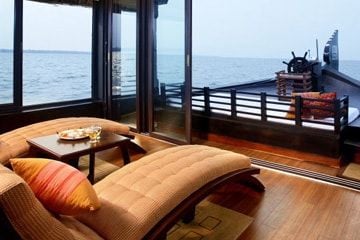
The interior of a luxury houseboat
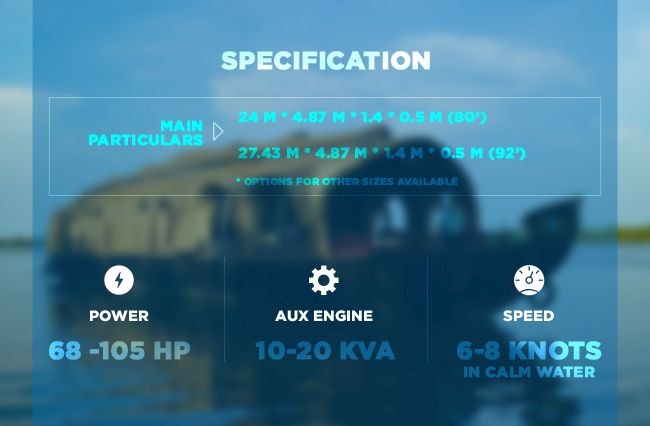
In Kerala, houseboats are being made by two companies, Grandeur Boatbuilders and Samudra Shipyard. Both make boats to suit customer tastes and specifications and they make a variety of sea-going vessels, ranging from canoes, water taxis, para-sailing boats, speedboats, fishing boats, pontoon boats, solar boats, souvenir boats (small-scale models) that can be gifted and even floating jetties. Specifications are normally as given below, but they can tailor-make it for you, as houseboats can be a two-bedroom version to a six-bedroom luxury floating home, hotel or even a restaurant.
Kerala houseboats are called ‘Kettuvallam’. In Malayalam language, Kettu refers to ‘dwelling structures’ and ‘Vallam’ means boat. These are boats with a thatched roof cover over wooden hulls. They were traditionally built 111 feet long, and made by tying together massive planks of wood. They were used as rice boats with a part of it covered with bamboo and coir as a kitchen and restroom for the crew. Since then, the humble houseboat has become the glamorous avatar it is now, as a holiday home away from home. What’s more is that fibreglass has replaced wood as the material of choice, as it provides more stability to the hull. Samudra Shipyard adheres to the Inland Vessel Act, 2010 to build its boats. The benefits of using fibre-glass over wood are: 

1. It is virtually maintenance-free when compared to wooden houseboats. They now have a lounge, dining area, open kitchen and modern bio-toilets. 
2. Fibreglass boats are not affected by marine growth and salt water. 
3. A FRP houseboat hull is ready within 30 days.

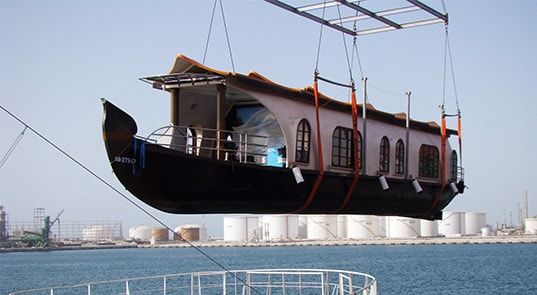
                                   A Samudra houseboat is being sent to Abu Dhabi
Samudra Shipyard’s Business Manager Dr Jeevan Sudhakaran answered a few questions on this exciting business.
Which are your bestselling boats?
 We have boats ranging from small canoes to houseboats which are more than 30 metres in length. The best-selling ones are our smaller versions used for personal transportation.
Who are your regular buyers and how much do the houseboats cost?
Our regular buyers are tour operators and government tourism departments. The price varies from about Rs 75 lakh for a single bedroom houseboat to Rs 1.75 crore for a four-bedroom luxury houseboat.
What's the resale value of your houseboats?
Being made of fibreglass, actually, the value doesn’t depreciate much as it is relatively maintenance-free. Even after 10 years, the boat can pretty much fetch the original price.
Is the second-hand market a good place to buy houseboats? Do you provide guarantee for second-hand boats?
Yes. But we don’t sell second hand boats.
How much does upkeep cost?
About 5 percent of the cost of the boat, per year.
How well is the boat-making business doing in the current market scenario?
Not very great.
Were there any unique design features that you had to add in any houseboat?
We study the local architecture and give our boats a local touch.
Which countries do you export to? I saw a picture of a boat going to Abu Dhabi.
Sri Lanka and Maldives. 

The dining room of a luxury houseboat

Samudra’s boats are built with space age technology, and with the help of the Industrial Design Centre of IIT Mumbai, which designs the superstructure, and the Department of Ocean Engineering, IIT Chennai, which has a tank-testing facility (and the only such facility in India). IIT Kharagpur and Kerala’s Department of Tourism are all part of this group endeavour, to make these gorgeous boats, a dream come true for many.

Written for CNBCTV18.com

Saturday, August 17, 2019

Why Lladro Sculptures are a Good Investment

Lladró, a Spanish luxury brand based in Valencia, creates such beautiful porcelain sculptures, lamps, candles and now jewellery, that owning a Lladro piece as a collectible makes so much sense. Since 1953, the brand has been a symbol of creativity and excellence in porcelain art across the globe. Their sculptures are considered a celebration of the best moments of life and are inspired by dreams, traditions, art and fantasy, with a timeless story behind each sculpture.
Take a look at the Carnival in Venice stunner and you will see something that needs to be preserved through the ages. Almost like a Bernini or a Michelangelo work of art, only obviously, more affordable and available!
Lladro's Mumbai Store Director Vinita Bist gave CNBC-TV18.com some pointers on which are their best-selling products and if their products appreciate in value. So, heed her advice and buy some pretty porcelain, which will make for a great-looking investment and a nice party conversation piece, at the same time.
Which are your best-selling products?
Lithophone’s Votive light /perfume candles is a good gifting choice along with other general categories like Indian (sculpture) pieces. Jewellery is a new concept and will take time to be accepted by the client.
Who are your regular buyers?
The starting range for a sculpture is Rs.11,000 and can go up to Rs. 1.80 crore. To buy a Lladro product, you should have love and taste for art. There is no specific income bracket that one needs to belong to, to possess a Lladro piece. Our clients range from corporates, politicians, Bollywood celebs, tourists and HNI clients, along with other general categories.
What's the resale value of your sculptures/light fixtures/jewellery?
Resale value for Indian pieces are more than other general pieces, as Indian Limited Edition pieces get sold out fast. On an average there is a price appreciation of 8-10 percent annually on all pieces. For eg: The Lord Ganesha statue was launched in the year 2000 and was priced at Rs.65,000. It was a Limited Edition of 2,000 units only. It sold out within 6 months. Now the same piece will fetch you Rs.15-18 lakh! On the other hand, there is no resale value for light fixtures and jewellery as these are functional items.
               
           Gita-Saar: The latest limited edition sculpture of 299 pieces

Is the second-hand market a good place to buy? Do you provide guarantee for second-hand products?
I would always suggest buying from a company-owned store, as your purchase will get register under LAP. In the secondary market, there is no assurance programme or guarantee for second hand products.
Is there any depreciation in the value of a Lladro product?
No, it always appreciates except for lighting fixtures and jewellery.
How can we tell genuine Lladro figurines from the fakes?
Every Lladro piece is embossed with a Lladro logo at the bottom of the piece and none can replicate the same. Look for the bow-tied tulip logo before you buy a product.
Do you make sculptures on demand, if it's out-of-stock?
If the piece is active, it can be procured from Spain. But if the piece is discontinued, it cannot be made on demand. Every year, we discontinue a few products, to make way for new designs.
So, head over to their store or check out www.lladro.com and start your collection today. You may soon realise you are spoilt for choice.
Written for CNBCTV18.com

Sunday, September 30, 2018

'It's not the How or the What but the Who'

I came across a Harvard Business Review webinar 'It's Not the How or the What but the Who: Succeed by Surrounding Yourself with the Best'. It was hosted by Claudio Fernandez Araoz, whose written the book 'It's not the How or the What but the Who'. (This title is from a Jeff Bezos quote made in an interview.) He is also a Partner at Egon Zehnder, which is into executive recruitment consultancy and leadership strategy services among other things.

In the book, he states that people's choices about friends, partners, spouses, mentors and employees are more important than they realise. You need the best people around you to thrive and yet very few people know how to do this well. I couldn't agree more with him because I've spent so many years of my life pruning away people who are a drain and liabilities and trying to add people who will bring out the best in me and help me succeed. I actually do have a similar motto, which is up on my Google profile.

So, once I knew it wasn't just a snobbish tactic on my part but an approved strategy at work, I wanted to see what tips Claudio had for companies to put together good teams. He did start off by comparing two top CEOs in the world today. Jeff Bezos of Amazon and Roger Agnelli of Vale (a Brazilian mining company). Both men have attributed their huge success in such disparate industries to their great teams.

Claudio also highlighted why this strategy is needed now more than ever. The reasons are:
- Globalisation: Many businesses are looking to find increased revenues - almost 70% - from emerging markets.
- Demographics: The developed countries are seeing a 30% decline in leaders in the 35-44 age group bracket.
- Pipelines: Companies have depleted pipelines of qualified successors. This problem like the above one will double in time. At the moment, half the VP level leaders in most companies that Claudio looked at, are close to retirement and half of those don't have successors lined up. A survey of 400 companies showed that successor training and planning is broken.

The webinar participants were told to take a poll and they all stated that the third factor, depleted leadership was what bothered them the most. Claudio suggested four ways to counter this issue:

- Focus on Potential: Good way to start but most assessors are clueless about how to judge potential. No one has an "empirically validated model" to predict a person's potential. Claudio suggests employers keep an eye out for these indicators: Motivation ("a fierce commitment to unselfish goals"), curiosity, insight, engagement, and determination.

- Master Retention: Key ways to retain people is to give them autonomy with regard to (task, time, team and technique), mastery, and purpose. These were recommended by Daniel Pink in his book 'Drive' and Claudio thoroughly agrees with them.

- Master Development: This was least looked into by many companies. Claudio's research shows that education makes up for 30% of development but on-the-job experience makes up for 70% of it. What also helped with development of potential was, in this order of priority - being given stretch assignments, job rotation and having personal mentors.

- Build Effective Teams: This is and will become an urgent need in the future: Surrounding yourself with the best people. This doesn't happen by chance. You need to know how to pick the best too. Talent spotting can't be left to the whims and fancies of people recommending their favourite and/or servile pets.

He has suggested and seen what team structures work best for a company turnaround, a new venture and a post-merger alliance.

1. A turnaround team has to be resilient and efficient.
2. A new venture's team has to be high on energy, openness and resilience.
3. A post-merger integration (PMI) team has to be balanced and aligned.

He also shares a case study of one of his 'finds' - Pedro Algorta. A person whom he recruited to be a brewery manager in Argentina and who then went on to become the CEO. This despite him not having the required competency but Claudio mined his past, and knew this man had the potential to do this job well. You need to see this portion of the webinar to know what this CEO endured to become the person he did.

I read the CEO's experiences on his own site a few months ago, and Claudio gives you a short version of it. From surviving a plane crash in the Andes to eating human flesh to survive..he did it all. He, and some of the other survivors have also been immortalised in a movie called 'Alive'.

I would like to work for such a person, but everyone doesn't have so much trauma in their past that makes him/her a wonderful type to work for, or with. I'll settle for people with some competency, a sense of fairness, and the ability to take criticism as much as give it to others. Oh...hmm..a dash of potential would also help!

What I loved best, was the way Claudio emphasized in the Q&A session at the end of the webinar, that women are the future of every workplace, all over the world. So start bucking up guys or leave, especially when you don't add much value to your jobs anyway.

Check out the webinar here: It's not the How or the What but the Who Graphics are from the webinar.
Ghostly Voice

The sound of his voice still thrills her and it brings back memories of a trip to Shimla. It was so soon after their marriage that it almost seemed like an extended honeymoon, so, they had been teased about it. "The lovebirds can't get enough of each other" was the common thread that ran through all the ragging but that hadn't changed their plans much. After all, they were going with friends who had just come down from abroad.

Bags were packed and they had flown away to a week of fun and reminiscing over hot cocoa, in front of a warm fire while the snow outside chilled everyone. The cold got through the windows no matter how tightly they were shut and that just drove her to the comfort and warmth of his arms.

They were all going to take the cable car ride over the gorgeous valley the next day. But she remembered getting up with a bad fever so he told her to stay tucked up in bed and he said he would be right there to get her anything she wanted - hot soup, medicines and lots of tender loving care - the best antidote of them all.

She said she was fine and insisted he carry on and have fun with the others and not fuss around her all day. But he said the others had already heard about her being unwell and knew he would want to stay with her. So, they had gone ahead to do some sightseeing. But she clearly remembered saying, "Go join them then and have fun."

He kissed her goodbye and went away to have a good time. She went to sleep and woke up at the end of the day to find he had not come back yet. She soon found out to her horror, that he was never really going to come back to her ever again.

The hotel manager told her, that he had decided to take the cable car ride by himself and had planned to come back to tease her imagination just enough, so she could go with him, when she got better. To cut a long story short...the cable car snapped and cruelly cut short the life of a young man...a young husband who didn't even know he had just become a young father.

He had plunged to the bottom of the valley, taking her heart and her sanity along with it. Grieving friends brought her back to her shell-shocked family. But she didn't feel anything. She kept asking for him as if he had just stepped out to buy groceries and hadn't returned yet.

He had left her some things, as if she needed any reminders of him. He had left her a recording of his voice. He had recorded a message for her just as he had got on the cable car and sent it to her mobile phone and that's the only voice she responds to...20 years later. The message haunts everyone else as being so prescient, as if he had known or felt something eerie was going to happen.

His message to her was: "The view here is so beautiful but if I were to choose the most beautiful thing that I want to see before I die, then it's you..will always be you."

He also gave her me - his daughter. She gave birth to me almost eight months later from the day he died but she didn't see him in me. Yet people always say I have my dad's looks.

Yet she doesn't recognise me. I realised long ago, I had lost her to that ghostly voice.

I wrote this short fiction story on a whim. Any resemblance to any living character is purely coincidental! I do assert this as being an original work, so if anyone is going to lift it for any purpose, atleast have the decency to request permission.

Written for the Spark Magazine

Saturday, April 14, 2018

Which status symbol wheels do you own?

Nothing screams money more than a luxury car. Now joining an exclusive club of hi-end car-owners - that comprises celebrities like Akshay Kumar, Bipasha Basu. Bobby Deol, Leander Paes and so many more – are first generation entrepreneurs, hedge fund managers, doctors, architects, lawyers, engineers and dotcom geeks with cash to spare.

There are a many luxury car brands vying for Indian wallets and the glamorous ones like Mercedes, Porsche, Audi, BMW are being spotted on India’s roads quite frequently. For the SUV aficionados, there is the Honda CRV, Porsche Cayenne, Land Rover, Audi Q7 and the Mercedes M Class.

Navnit Motors which is the Indian franchisee for BMW and Land Rover has seen a surge in sales of these cars in the recent past. Though, BMW has been in India for the past 12-15 years, sources at Navnit Motors say that they are selling almost 40 cars in a month now.


                  Image source: Autocar 

So even though the BMW 3 series and 5 series are the popular ones to go out of their showroom, they are not cheap by any stretch of the imagination. For these cars, the EMI works up to Rs 60,000 pm and if anyone is going for the upper-end of the spectrum BMW (for eg. a 7 series), then the EMI can go up to a whopping Rs 2.5 lakhs per month.

BMW Model - Price of the car
3 Series - Rs 27 lakhs
5 Series - Rs 37 lakhs
6 Series - Convertible Rs 87.90 lakhs
Coupe - Rs 79.70 lakhs
7 Series - Rs 74 lakhs

But whatever the price, the cars are selling like hot cakes because nothing beats the German engineering that comes packaged in sexy, stylized metal. So, though Audi is in India to heat up the competition, sources at Navnit Motors say there are not too worried because they have a headstart to begin with and atleast in Mumbai, where Audi doesn’t have a showroom - therefore after-sales service and spares are difficult to procure - they think of the Mercedes as being their closest competitor.

Though, sources tell me that an Audi showroom is set to open in Mumbai in July this year and that will bring in premier models like the A3, A4, A6 and the Q7 onto Mumbai roads.

Similarly, Precision Cars India Private Limited, the firm which has imported Porsche into India is not losing sleep over Ferrari’s recent entry into India – or so it claims. Chief Executive Officer, (CEO) Ashish Chordia actually welcomes the competition and says, “We believe that competition is very healthy and we together are growing the industry in our market. With the superiority of our products and the great success Porsche experiences worldwide, we have no doubts that the Indian market will meet our growth expectation.”

He adds that, it’s customers who differentiate between brands because of their emotions associated with a particular brand. In other words, there is space for everyone to play on people’s perceptions and emotions.

Besides he believes that there are a million potential luxury car buyers in the country and though the sales figure is currently at 5,000 cars, there is immense growth waiting to be tapped by everyone. What’s more, his dealerships are willing to finance the purchase. With these sleek cars starting from a price range of Rs 47 lakhs and going all the way to Rs 86 lakhs for the SUV, the Cayenne – some people will surely jump at this opportunity to show-off their money.

Porsche Model - Price of the car
Boxter S - Rs 47 lakhs
Carrera - Rs 63 lakhs
Carrera S - Rs 71 lakhs
Cayman S - Rs 52 lakhs
Cayenne V6 - Rs 47 lakhs
Cayenne S - Rs 61 lakhs
Cayenne Turbo - Rs 86 lakhs

The other status-symbol SUV to own is the Land Rover. Beginning with a price tag of Rs 1.25 crore, this marquee brand that belongs to the Ford family is just what the nouveau riche are riding around in, these days.

Sources at Navnit Motors say that there are three models to choose from in this brand – the Range Rover, Range Rover Sport and the Discovery. With the EMI for a base model coming to around Rs 1.50 lakhs, these wheels symbolize wealth, like nothing else.

Here again, confidence reigns when it comes to selling more of these SUVs. Though a sales figure was not forthcoming, (projected or otherwise), sources said that they considered the Porsche Cayenne and the Audi Q7 as the brands which could cannibalize their sales.

Land Rover Model - Price of the Car (Rs Cr)
Range Rover - Rs 6.67 lakhs
Range Rover Sport - Rs 4.30 lakhs
Discovery - Rs 3.29 lakhs

This will happen ofcourse, only when more Indians start to think big and spend lavishly, and when they realize that there is such a buffet spread out there. At the moment, all the brands have their exclusive, small number of clientele, therefore the money is being thrown out generally at the few by the few.

So, it’s probably safe to say that to make a choice between brands is not easy. To figure out how the rich make up their mind to pay for such expensive wheels, may be every marketing consultant’s dream come true. But for the moment, everyone is going by gut feel and good old brand-building.

Chordia explains, “We are working to establish the Porsche brand in the Indian market with the same standards as they would be anywhere in the world. Therefore we are preparing ourselves for a great future ahead. Currently, we have approximately 500 vehicles of Porsche available in the Indian market.”

So, are Indian customers discerning and demanding as well? Do Indians ask for radical makeovers or for vanity plates, a bar, DVD-TV gizmo combination? Apparently, they do. Sources at Navnit Motors say that though the 3 series and 5 series is imported as completely knocked down (CKDs) kits and assembled here, any such add-ons have to be told well in advance and for the higher end series, which comes straight from abroad, the same situation prevails. So, cherry-picking you accessories well in advance is the way to go because they absolutely don’t tinker with the car once it’s in India.


                       Image source: Autocar

With Porsche, Chordia explains, “The concept behind Porsche Design Driver’s Selection looks beyond the vehicle. Not only do we take the wishes of Porsche drivers into consideration. We also go one step further to include anyone with a passion for Porsche. The result is a range of superb products that combine high-quality materials, exclusive design and truly individual character.”

“For eg. Take the Porsche Cayenne collection, – a truly versatile range of meticulously finished, functional and stylish products, which are developed to meet the challenges of everyday life. With a combination of classic, elegant design and modern materials, the 911 Swarovski
collection reflects those special moments in life – just like the 911 (model) itself.”

“We have a huge list of possible options that can be offered to the customers. However, if a customer comes up with any specific request, we are happy to fulfill it.”

All the luxury car brands are out to get customers with just such great assurances. So, what’s there to lose? Have the money…then go spend!

(Never wrote this for any mediocre car site).

Friday, March 17, 2017

How the ultra-rich spend their stash

Do you have any idea what sort of spender are you? The conscientious kind or the impulsive kind or just the plain foolish kind? Or are you just too broke to do the spending you wish you could do! Either way, I came across a report by Kotak Wealth Management that was done last year, which shows how ultra high networth individuals (HNI) spend their cash. Ironically, while investing was a priority, saving money was not. These graphics tell their own stories..


What I liked best about this report was how it points out that 97% of ultra HNIs spend "not much" but "less than Rs 25 lakhs" in a year on art. But the remaining 3% probably make up for it, by spending between Rs 25-50 lakhs anyway. For many people, with that much money, they would rather buy a home! Also, they bought art because they are passionate about it but wearables were on show for social status. Sort of like flaunting expensive cars. Some things don't change.

Thursday, December 01, 2016

MAID: Stylish Aid To Jazz Up Cooking

If you have waited for someone to come up with a ‘connected microwave oven’, that would flash or show you recipes, just when you wanted inspiration to cook up something scrumptious, rather than having to read it from a book or off a website, then MAID (Make All Incredible Dishes), a smart, multi-functional oven, has been designed for people just like you.
MAID has been made by SectorQube, which is an Internet of Things (IoT) startup set up in October 2011 by six friends, that now employs 14 people. Nibu Alias is the CEO of the company. To raise funding, they ran a Kickstarter campaign for introducing MAID across the globe. SectorQube Inc, a US entity, was setup for the same reason. The campaign raised $123,920 in 35 days and they got 200 pre-orders. The goal had been to raise $50,000, which was done in an amazing six days!
So here are some of MAID’s wow features as shared by SectorQube:
1. It has touch interface rather than the usual buttons
2. A recipe database, connected via Wi-Fi that provides an unlimited number of recipes to the MAID interface
3. MAID can be controlled via touch, gesture and voice, and it is the only oven to have these features
4. MAID has a personalisation engine that can learn a user’s cooking habits and calorie needs, and can suggest recipes based on them

What really inspired the team to come up with such a ‘with it’ appliance, was their own lives. SectorQube, Co-Founder & CBDO, Sabarish Prakash told Networked India, “We were bachelors living in an apartment and we did not know how to cook. We depended on restaurants for food and in Kerala, where anyone can declare a hartal (strike) at any moment, it was not sustainable. We wanted something that could cook on its own – that was the idea. From there, we moulded an idea into something practical. That was how MAID was born.”
He added, “We had a soft launch in 2012. We were surprised by the coverage that it got. We got more than 1,000 pre-orders, but we were in no place to complete them. We did not have enough capital for manufacturing. So we had to drop all those pre-orders.”
We went ahead with licensing the technology to home appliance companies, but no one was ready to bring such a big change to the market. We wanted to market the product more in the western markets and also establish its market validity. That is when we decided to go for the Kickstarter campaign.”
Their moment of glory has come because MAID has got international acceptance now, as the same global home appliances companies who did not want to license the technology from them initially, are now contacting them.

Prakash says, “Even though we struggled initially, and at times thought that the product was maybe not good enough, we continued improving and going forward. And it got us on the path of success.”
The company has also implemented better and easier human-to-machine communication. What’s more, SectorQube has major industry leaders like Godrej and IFB on their client list, with more of them lining up.

Written for Ericsson.

Tuesday, November 01, 2016

Nano Origami Drone: The Economical Spy Paper Plane

If you remember the gorgeous, chocolate cake-like Taj Mahal hotel in Mumbai being stormed, first, by terrorists and then by commandos flushing out those cowardly creeps; then someone else was also affected by that sight.
B. Madhan Kumar watched the news on that day and felt for the commandos going in blindly because “no one knew what was happening inside. So, after that, I wanted to make a simple spying device which makes defence operations easier and at the same time, it must be economically efficient to adopt”, he told Networked India.
He seems to have figured out how to do that. An M.E degree in Aeronautical Engineering from the Madras Institute of Technology has also certainly been put to good use, because he has mixed some really nifty high-level science and kindergarten level craft, to come up with a paper plane, that’s more than a toy that we played with as kids.
His paper unmanned aerial vehicle (UAV) is actually a drone that can be used to defend a country! He said, “My innovation is Nano Origami Drones that can be used for surveillance by the defence department. It is a simple paper plane with in-built nano avionics system. It also includes a camera with wireless transmission.”
“This is the only origami (paper built) flying surveillance system that can be used for indoor and outdoor surveillance.It is a soldiers’ gadget and can be used only once, as it only made out of paper. It reduces the stress of getting back a drone in the middle of a war.”
He has managed to make this drone for an unbelievably cheap Rs 1,000 and has applied for a patent. He explained, “I have chosen ordinary paper as material and on analysis, it has proven that a simple 80 Grams per Square Metre (GSM) paper resembles having the properties of aluminium.”
From my childhood, I am good at making paper planes. I know the
efficiency of paper planes in the open air. I also got some prizes at national level contests for the ‘Best Paper Plane designed for the Highest Range and Endurance (flight time)’. It took almost two years to get the right weight which can be accomodated by a paper. Finally, I made it fly inside and outside along with a camera.”
In a research paper that Madhan has written on his UAV, he has stated that it requires a certain altitude to perform well. “The control surfaces are fully active at an altitude of 20 to 70 feet. This altitude gives enough time for the paper plane to stabilize itself.” So it is required that the UAV is “dropped at least from 20 feet.” For example: If a user wants to survey a building from indoors or outdoors, this plane has to be dropped from the top floor. Then “it is very efficient and controllable.”
He has done this project on his own because people have laughed off his endeavour and told him “don’t do any dream as your project.” But he has persevered because he says, “I know the power of my motors and the efficiency of paper. Whenever someone says. “It is not at all possible to fly this thing”, I take those words as fuel, and do more, to make it fly. And ofcourse I got moral support from my department head, Dr V.K. Shanmuganathan and a DRDO scientist, Rajesh. They were able to visualise my thoughts and always inspired me to keep going with my project.”
He has amply justified these people’s faith in him. He was awarded the ‘Dr Walter Kohn Award for Innovation’ in 2014 by Satyabama University and is the first person to receive it for an aerial project. This has spurred him on to doing even more with his paper plane UAV. He has now even developed a vertical takeoff and landing system too.
Now all that is required is, for these paper plane drones to take off, with the right people in the right places.

Taparch: ‘Sensing’ Shoes Will Help The Blind Move Around Easily

Krishna Sai Inkoolu is the Founder & Director at Taparch Footwear Pvt Ltd. So, what is so great about this footwear-maker anyway? Well, his shoes help blind people and those having less than 15 degrees of visual field, identify and isolate obstacles within a range of 400 cms. It is currently in the pre-incubation stage, and is already in the market and is priced feasibly. Taparch has been tested at the National Association of the Blind and Krishna wants to scale the trial to a national level.
Krishna was a student at the Gandhi Institute of Technology and Management (GITAM), when he was motivated to help visually impaired people live more dignified lives. While they navigate around the world with their white/red canes, they are visible to us, as being seriously at a disadvantage, which they indeed are. These shoes quietly guide them without announcing their blindness to the world.
To design these shoes, Krishna observed how they moved around. As he told Techpedia, “We keenly observed the conventional walking methods of the visually impaired. While 80% of them used Hoover canes, the rest were dependent on echolocation. Therefore, we realized that there was no significant and economical technology available to cater to the needs of the visually impaired. With that thought in mind, we invented Taparch, that works on the principle of “Sense of Touch”, and lets the user identify the distance and dimension of the obstacle ahead.”

While he states that the technology behind the shoe has been easy to crack – converting mechanical energy into power – it is also much less expensive and more user-friendly. Well, all that electrical energy generated can also be used to recharge the user’s phone, while he/she is walking!
The shoes work with a sensor that “is placed at the weld point of the shoe, which identifies the obstacle and gives a tap on the arch of the shoe. With the help of micro-electronics, the entire circuit is placed in the shoe socket, which has a connection with the weld point where the sensor is placed”, reported Moneycontrol. The shoe works on a rechargeable battery and doesn’t need a smartphone.
Krishna realised it was important to know when the sensor was not working since there is no system that is fail-proof. So he has embedded a “mistake-proofing” device in the shoe to pick up on any errors. If the sensor fails, it raises an alarm to alert the wearer.
Shoes don’t come anymore hip than these! Now, if only Krishna can offer colour options…
Written for Ericsson's blog: Networked India